Automotive PPC in 2026: How Dealerships Should Structure Search, VLAs, and Performance Max
The average U.S. car dealership spends $44,077 per month on advertising, according to 2023 NADA data. Roughly 72% of that goes to digital channels, with search engine marketing taking the largest share.
Most of that digital budget runs through one campaign type: standard Search.
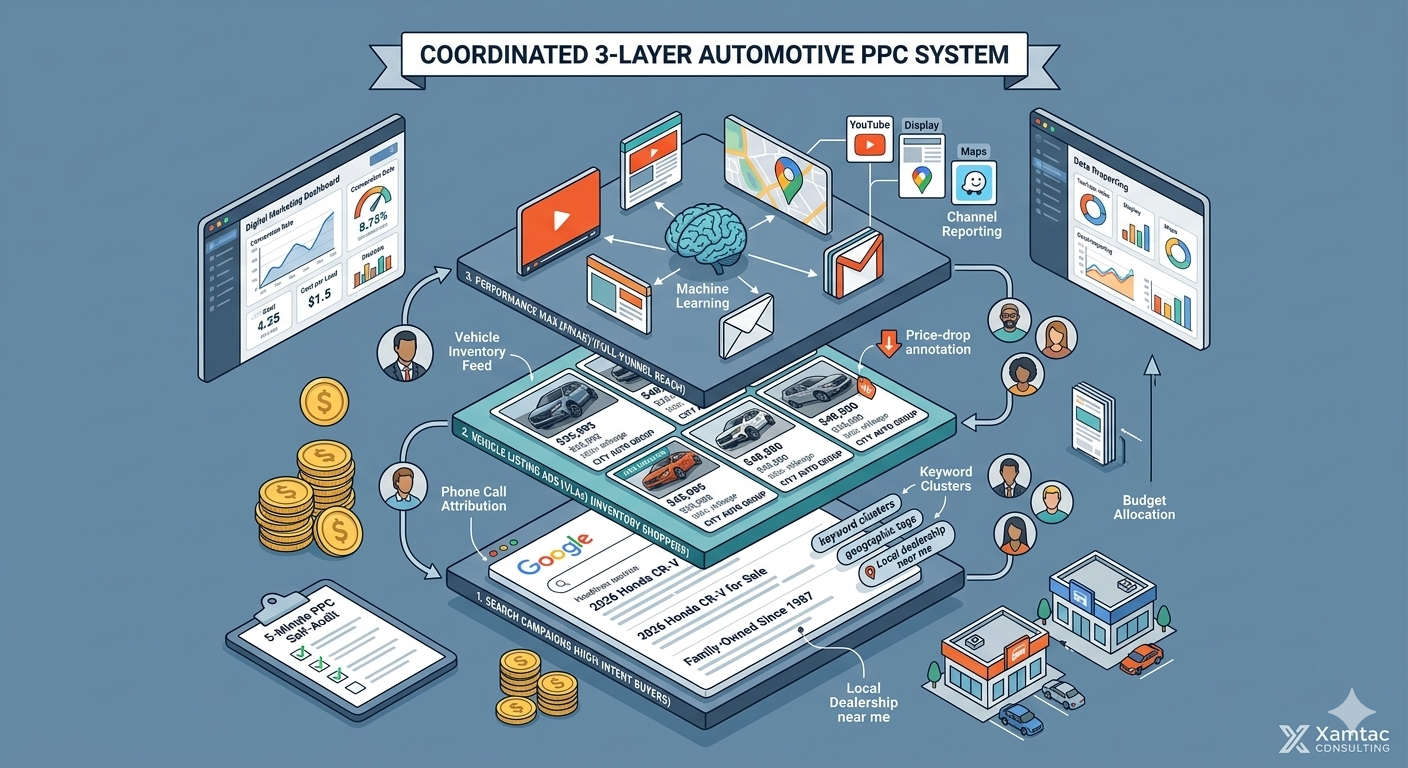
That is not necessarily wrong. Search campaigns still capture high-intent buyers. But dealerships that run Search alone are missing two campaign formats that consistently lower cost per lead and increase qualified traffic: Vehicle Listing Ads (VLAs) and Performance Max with vehicle feeds.
This guide covers how to structure all three layers into a coordinated system. You will get campaign architecture for each format, industry benchmarks to measure your own performance, budget allocation starting points by dealership size, and a self-audit checklist you can run on your account this week. PPC is one piece of a broader automotive digital marketing services strategy, but it is the piece where budget waste shows up fastest and fixes pay off soonest.
Why Most Dealership PPC Accounts Underperform
The Single-Campaign Trap
Here is the pattern. A dealership sets up Google Ads, builds out Search campaigns targeting make-model keywords and "dealership near me" terms, and allocates the full monthly budget there. The campaigns generate clicks and some leads. The cost per lead hovers around $38.86 (the industry average for automotive search ads). Nobody is sure whether that number is good or bad, because there is nothing to compare it against internally.
Meanwhile, inventory-specific shoppers searching for a 2025 Toyota Camry with photos and pricing never see the dealership's ads in the visual listing format. Full-funnel buyers who are still researching on YouTube, Gmail, and Google Maps never encounter the brand at all.
The single-campaign structure is not broken. It is incomplete.
What Three-Layer Accounts Do Differently
Dealerships with the strongest PPC results in 2026 run three campaign types in parallel, each with a defined role:
Search campaigns capture buyers actively searching for vehicles, dealerships, or specific models. These are your highest-intent clicks.
Vehicle Listing Ads (VLAs) show individual vehicles from your inventory, with photos, prices, and mileage, directly in search results. Industry data suggests VLAs deliver a cost per lead between $25 and $45, compared to the $38.86 average for standard search.
Performance Max campaigns extend your reach across YouTube, Display, Discover, Gmail, Maps, and Waze, using Google's machine learning to find buyers across the full funnel.
The three layers are not competing for the same clicks. Each one reaches a different segment of the buying journey. When they run together, total cost per lead tends to drop because VLAs and Performance Max pick up conversions that Search campaigns cannot reach on their own.
Layer 1: Search Campaigns for High-Intent Buyers
Search is still where most dealership PPC budgets belong. Industry benchmarks for automotive search ads show an average CPC of $2.41, a click-through rate of 8.29%, and a conversion rate between 5.72% and 7.76% (April 2024 through March 2025 data). Those are strong numbers compared to most industries. The key is structuring your campaigns so you are not leaving performance on the table.
Campaign Structure by Inventory Type
The most common structural mistake is running one campaign for all vehicle inventory. A single campaign lumps new, used, and certified pre-owned inventory into the same budget, the same bids, and the same ad copy.
Split your campaigns by inventory type:
New vehicle campaigns. Target make-model-year searches ("2026 Honda CR-V"), trim-level searches, and branded dealership plus make combinations. These buyers are often further along in their decision and willing to visit for a test drive.
Used vehicle campaigns. Target broader terms ("used SUVs under $25,000"), year-make-model combinations, and value-oriented searches. Used buyers tend to have wider consideration sets, so your keyword coverage should match.
Certified pre-owned (CPO) campaigns. Separate from general used inventory. CPO buyers specifically search for certification terms and want the warranty and inspection messaging front and center.
This segmentation lets you set different bids for each category (new inventory typically supports higher CPCs), write ad copy that matches the buyer's mindset, and track performance by inventory type rather than guessing which segment is driving results.
Keyword Strategy for Dealerships
Dealership keyword strategy works in three layers.
Make-model terms are the highest-intent keywords. "2026 Ford F-150 for sale" or "new Toyota RAV4 near me" signals a buyer who knows what they want. Bid aggressively on the models you carry in stock. Do not bid on models you cannot deliver.
Geographic terms matter more for dealerships than for most industries. "Honda dealer Chicago," "used cars Springfield IL," and "car dealership near me" capture local buying intent. Layer location targeting on top of geo-modified keywords to avoid paying for clicks from shoppers who will never visit your lot.
Negative keywords are where most dealership accounts leak budget. Add negatives for:
Competitor dealership names (unless you are running conquest campaigns intentionally)
"Jobs," "careers," "salary" (people searching for dealership employment)
"Recall," "lawsuit," "complaint" (informational searches with no purchase intent)
"Free" and "giveaway"
Makes and models you do not carry
Review your search terms report weekly. Most dealerships that do this for the first time find 15% to 25% of their budget going to irrelevant queries.
Ad Copy Patterns That Convert
Automotive search ads perform best when the copy matches the specificity of the search. Three patterns consistently produce strong click-through rates.
Inventory-specific headlines. If someone searches "2026 Chevy Silverado 1500," your headline should include "2026 Chevy Silverado 1500," not "Great Trucks at Low Prices." Dynamic keyword insertion can help here, but review the output regularly. Auto-generated headlines sometimes produce awkward combinations.
Price or incentive-led descriptions. "Starting at $34,995" or "$3,000 Off MSRP This Month" gives the searcher a reason to click your ad instead of scrolling. If you can include a real number, include it.
Trust signals in the third headline slot. "Family-Owned Since 1987" or "4.8 Google Rating, 1,200+ Reviews" builds credibility without taking space from the primary offer. Avoid generic phrases like "Best Deals" that every competitor uses too.
Layer 2: Vehicle Listing Ads for Inventory Shoppers
Vehicle Listing Ads are Google's automotive-specific ad format, and they are the single biggest opportunity most dealerships are not using yet.
How VLAs Work (and How They Differ from Shopping Ads)
VLAs display individual vehicles from your inventory directly in Google search results, complete with photos, pricing, mileage, and dealership name. Visually, they look similar to Shopping ads for retail products. Functionally, they are built for automotive.
The core difference: VLAs pull from a vehicle inventory feed in Google Merchant Center rather than a product catalog. Each listing represents a specific VIN on your lot, not a generic product. When a shopper clicks, they land on that vehicle's detail page (VDP) on your site.
The performance numbers are worth paying attention to. Industry benchmarks show VLAs achieve 67% lower CPC compared to standard search ads and generate up to 2,100% more impressions for the same budget. A Google beta study with participating dealerships reported a 25% increase in conversions and a 15% improvement in ROI when VLAs were added to an existing search campaign.
Vehicle Feed Optimization
Your VLA performance is only as good as your vehicle feed. Google uses the feed data to match your inventory to shopper searches, so accuracy and completeness directly affect how often your vehicles appear and whether shoppers click.
Feed fundamentals that affect performance:
VIN-level listings. Every vehicle on your lot should have its own entry in the feed. Do not group vehicles by model. Each listing needs its own VIN, price, mileage, and images.
High-quality images. Multiple angles per vehicle. Actual photos of the vehicle, not stock images. Google prioritizes listings with stronger visual assets.
Accurate, current pricing. If the price in your feed does not match the price on your website, Google will flag the inconsistency. That can reduce impressions or trigger disapprovals. Sync your feed with your inventory management system daily.
Complete attribute fields. Fill in every available field in Google Merchant Center: year, make, model, trim, body style, color, transmission, fuel type. More complete listings match more queries.
After the November 2025 update, Google added Price Drop and Low Mileage annotations to VLAs. If a vehicle's price drops below its recent average, or if the mileage is notably lower than comparable listings, Google highlights these attributes automatically. Keeping your feed accurate and updated frequently increases the chance your listings qualify for these annotations.
VLA Bid Strategy and Budget
Google recommends a minimum of $3,000 per month ($100 per day) for VLA campaigns. That is the floor for generating enough data for Google's bidding algorithms to perform effectively.
For bid strategy, start with Maximize Clicks to build initial data, then shift to Target CPA or Target ROAS once you have at least 30 conversions in 30 days. Rushing to automated bidding without conversion history leads to erratic spend.
The November 2025 update also added campaign-level negative keywords for VLAs, full channel performance reporting, Waze ads integration, and Call Assets. Campaign-level negatives mean you can now prevent your VLAs from showing for irrelevant terms (previously, negative keyword control was limited). Channel reporting lets you see where your VLA impressions and clicks are coming from. These were two of the biggest complaints from dealers about VLAs before the update, and both are now resolved.
Layer 3: Performance Max for Full-Funnel Reach
Performance Max is Google's automated campaign type that serves ads across every Google-owned surface: Search, YouTube, Display, Discover, Gmail, Maps, and Waze. For dealerships, it covers the top and middle of the funnel that Search and VLAs do not reach.
When Performance Max Makes Sense for Dealerships
Performance Max is not a replacement for Search or VLAs. It is an addition.
Industry benchmarks show Performance Max campaigns deliver 48% more conversions than standard search campaigns when measured across the full funnel. That number makes sense because PMax reaches buyers earlier in the process: someone watching a vehicle review on YouTube, reading a car comparison on the Display Network, or checking Google Maps for nearby dealerships.
Use Performance Max when:
Your Search and VLA campaigns are already running and have stable conversion data
You want to reach buyers who have not started searching for specific vehicles yet
You have strong creative assets (images, video, headlines) to feed the algorithm
Your monthly budget supports a third campaign type without starving Search or VLAs
Do not use Performance Max as your only campaign type. Without Search and VLAs handling high-intent traffic, PMax will spend most of its budget on lower-intent impressions that are harder to convert.
Asset Groups and Audience Signals
Performance Max campaigns are built around asset groups, not keywords. Each asset group contains a combination of headlines, descriptions, images, videos, and audience signals that Google uses to assemble ads across its network.
For dealerships, structure your asset groups around:
New inventory (with images and headlines specific to current model-year vehicles)
Used and CPO inventory (with value-oriented messaging and price points)
Service and parts (if you want to capture service appointment leads alongside sales)
Audience signals tell Google who to prioritize, though the algorithm may expand beyond them. Set signals for:
Custom segments. People who have searched for specific makes and models, dealership-related terms, or competitor dealer names.
Your data. Website visitors, past customers, CRM lists of service customers or lease-expiration contacts.
In-market audiences. Google's pre-built segments for "Autos and Vehicles" subcategories, including new car buyers, used car buyers, and specific makes.
Reading Performance Max Reports After November 2025
Before the November 2025 update, Performance Max reporting was a black box. You could see total conversions and cost, but not which channels (YouTube, Display, Search, Maps) drove the results.
That changed. Channel-level reporting now shows how your PMax budget splits across YouTube, Display, Search, Discover, Gmail, Maps, and Waze. For dealerships running PMax, this is the most important reporting upgrade, because it reveals whether the algorithm is spending on high-intent placements (Search, Maps) or upper-funnel display inventory.
Review your channel distribution monthly. If more than 60% of your PMax spend is going to Display with low conversion rates, your asset quality or audience signals likely need adjustment. If Maps and Search are driving conversions efficiently, your PMax setup is working as intended.
Budget Allocation by Dealership Size
You now understand all three campaign layers. The next question: how much should go to each?
There is no universal answer. Budget splits depend on your inventory size, market competitiveness, and how much conversion data you have. But the following tiers offer a starting point grounded in the industry benchmarks discussed above.
$15K-$25K/Month (Small Dealership)
At this budget level, focus the majority on the highest-intent channel.
Search: 60-70% ($9,000-$17,500). Your primary lead driver. Fund your make-model and geo-targeted campaigns fully before allocating elsewhere.
VLAs: 20-25% ($3,000-$6,250). Meet Google's $3,000 minimum and give the algorithm enough budget to match your inventory to relevant searches.
Performance Max: 10-15% ($1,500-$3,750). At this budget, PMax is a test. Run it with tight audience signals and evaluate monthly. If conversions are not appearing within 60 days, reallocate to Search and VLAs.
$25K-$50K/Month (Mid-Size Dealership)
This budget allows a more balanced three-layer approach.
Search: 50-60% ($12,500-$30,000). Expand keyword coverage to include more long-tail and conquest terms. Fund separate campaigns for new, used, and CPO.
VLAs: 20-25% ($5,000-$12,500). Increase budget beyond the minimum to cover more of your inventory. Larger feeds need more budget to maintain impression share.
Performance Max: 15-25% ($3,750-$12,500). Enough budget for PMax to build meaningful data across channels. Use audience signals tied to your CRM data for better targeting.
$50K+/Month (Large or Multi-Rooftop Group)
Multi-location dealerships and large single-rooftop stores can fund all three layers at scale.
Search: 45-55% ($22,500+). Full coverage across all inventory types, with separate campaigns by location if you operate multiple rooftops.
VLAs: 20-25% ($10,000+). Fund VLAs proportional to your active inventory count. More VINs in the feed require more budget to maintain visibility.
Performance Max: 20-30% ($10,000+). At this budget, PMax becomes a genuine full-funnel reach channel. Layer in video assets for YouTube placements and use conquest audience signals targeting shoppers who visit competitor websites.
These are starting points. Adjust monthly based on cost per lead, conversion volume, and which channels are producing the most qualified traffic for your dealership.
For a budget allocation tailored to your specific market and inventory mix, a free PPC consultation can help.
Phone Call Attribution: The Metric Most Dealers Miss
Here is a number worth remembering: 61% of automotive shoppers call after clicking a search ad.
For most dealerships, phone calls are the highest-value conversion type. A shopper who picks up the phone is further along than one who fills out a lead form. Yet many dealership PPC accounts track form submissions only and ignore call data entirely.
That creates a measurement blind spot. You cannot steer campaigns toward your best leads if you do not count them.
Basic call attribution setup:
Enable call extensions on all Search campaigns. Google provides a forwarding number that tracks which ad and keyword triggered the call.
Set up call reporting in Google Ads. Configure a minimum call duration threshold (typically 60 seconds) so brief misdials do not count as conversions.
Use call tracking numbers on your landing pages. Third-party call tracking assigns a unique phone number to PPC visitors so you can attribute calls to specific campaigns, even if the shopper calls later. Monitor this data alongside your other metrics in a PPC performance dashboard.
Include call conversions in your bidding strategy. If you are using Target CPA or Target ROAS, phone call conversions need to be in the data. Otherwise, the algorithm focuses only on form fills, which may not be your most valuable lead type.
Without call tracking, you are likely underreporting PPC conversions by 30% to 50%. That gap makes your cost per lead look worse than it is and can lead to underinvesting in campaigns that are performing well.
The 5-Minute PPC Self-Audit
You have read the full breakdown. Before anything else, run this quick audit on your current dealership PPC account. Check each item and note where you have gaps.
Campaign structure:
Separate campaigns for new, used, and CPO inventory (not one campaign for everything)
Vehicle Listing Ads running with an active vehicle feed
Performance Max running with at least one asset group and defined audience signals
Keywords and targeting:
Negative keyword list includes job-seekers, recall searches, makes you do not carry, and "free"
Search terms report reviewed in the last 14 days
Geographic targeting set to your actual service area (not "all United States")
Measurement:
Call tracking enabled with call extensions on Search campaigns
Call conversions included in your bidding strategy
Conversion tracking firing correctly on lead form submissions and VDP views
Feed and creative:
Vehicle feed updated daily with current pricing and inventory
Ad copy includes at least one specific number (price, incentive, review count)
Auto-created ads reviewed and poor performers paused
Most dealerships that run this checklist for the first time find 3 to 5 items unchecked. Each unchecked item represents either wasted budget or missed conversions.
If the audit surfaced gaps you want a second opinion on, Xamtac offers a professional PPC audit for dealerships. No pitch, no obligation. You will get a written breakdown of what is working, what is leaking budget, and where your account has room to grow. Request a free PPC audit.
Frequently Asked Questions
How much should a dealership spend on Google Ads per month?
The 2023 NADA average is $44,077 per month on total advertising, with about 72% going to digital. For Google Ads specifically, dealerships typically allocate between $15,000 and $50,000 per month depending on market size, inventory volume, and competitive density. The floor for running all three campaign types (Search, VLAs, and Performance Max) effectively is around $15,000 per month, primarily because VLAs need at least $3,000 monthly to generate usable data.
What is a good cost per lead for a car dealership?
Industry benchmarks put the average automotive search ad CPL at $38.86. Vehicle Listing Ads tend to deliver leads between $25 and $45 per lead. A "good" CPL depends on your average gross profit per vehicle sold and your lead-to-sale conversion rate. If your average front-end gross is $3,000 and you close 10% of leads, a $50 CPL means you are spending $500 in ad costs to generate a $3,000 sale. Work backward from your own margins to set your target.
Is PPC worth it for car dealerships?
Industry data suggests an expected return of about $2 for every $1 invested in automotive PPC. That return comes with caveats: it assumes proper campaign structure, accurate conversion tracking (including phone calls), and an inventory feed that keeps ads relevant. Dealerships that run a single campaign type with no call tracking often see much lower returns, not because PPC itself fails, but because the setup is incomplete.
What is the difference between Google Vehicle Ads and standard search ads?
Standard search ads are text-based and triggered by keyword bids. Vehicle Listing Ads are image-based and triggered by your vehicle inventory feed in Google Merchant Center. VLAs display a specific car from your lot (with photo, price, mileage, and dealer name) directly in search results. The shopper clicks through to that vehicle's detail page on your website. Benchmarks show VLAs achieve 67% lower cost per click and up to 2,100% more impressions compared to standard search ads for the same budget.
How long does it take for dealership PPC to show results?
Search campaigns typically generate clicks and leads within the first week if your bids are competitive for your market. Meaningful data for bid adjustments, pausing underperformers, and reallocating budget usually requires 30 to 60 days. VLA campaigns need at least 30 days and 30 conversions before automated bid strategies produce reliable results. Performance Max generally takes 4 to 6 weeks of learning before channel distribution stabilizes.
Should dealerships spend more on Google Ads or Meta Ads?
For most dealerships, Google Ads should receive the larger share because it captures active purchase intent: people searching for specific vehicles, dealerships, and pricing. Meta Ads (Facebook and Instagram) work differently. They reach people who are not actively searching but match your target buyer profile. Meta is strongest for awareness, retargeting past website visitors, and promoting specific events (sales weekends, new model launches). A common allocation is 70-80% Google, 20-30% Meta, adjusted based on which platform delivers a lower cost per qualified lead in your specific market.
Automotive PPC in 2026: How Dealerships Should Structure Search, VLAs, and Performance Max
Marketing Automation Agency
Small Business Marketing Agency
10 Ways a PPC Marketing Agency Can Transform Your Online Presence
Automotive PPC in 2026: How Dealerships Should Structure Search, VLAs, and Performance Max
Learn how to structure dealership PPC with Search, Vehicle Listing Ads, and Performance Max. Includes benchmarks, budget splits, and a self-audit checklist.

Marketing Automation Agency
Dive into the world of marketing automation with this comprehensive guide to hiring a marketing automation agency. Learn about the role of marketing automation, identifying your needs, understanding the importance of hiring an agency, potential drawbacks to avoid, choosing the right agency, onboarding, evaluating success, and more.

Small Business Marketing Agency
Discover how to navigate the crowded landscape of marketing agencies and choose the perfect partner for your small business. From understanding the role of marketing agencies to setting realistic goals and evaluating performance, this comprehensive guide will empower you to make the right choice and drive sustainable growth for your business.

10 Ways a PPC Marketing Agency Can Transform Your Online Presence
Explore how a PPC marketing agency can revolutionize your business’s online presence with our guide to ten strategic benefits. From precise keyword research to continuous campaign optimization, discover how expert PPC management can drive targeted traffic and increase conversions effectively.